
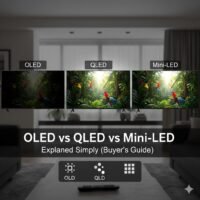
Introduction
Trying to decide between an OLED TV, Mini-LED TV, or QLED TV is one of the first challenges you will pace when you decide to buy a TV. All three promise stunning picture quality, yet they all achieve it in different way. This choice of yours will directly affect your movie nights, gaming, sports viewing, and every other viewing utility of your TV. Some TVs shine in dark home-theater setups, while others dominate bright living rooms.
This guide will help you this first hurdle. It will break down OLED vs QLED vs Mini-LED in simple terms to help you choose the right TV technology for your needs.
How Each TV Technology Works
Understanding how a TV creates light and color is the key understanding needed to compare these technologies. Contrast, brightness, HDR performance, and even price all vary due to this core difference.
OLED TV Explained (Organic Light-Emitting Diode)
OLED TVs use self-emissive pixels. This means that every pixel produces its own light. There is no backlight in this type of TV.
Each pixel can turn completely on or completely off, thus delivering:
- Perfect black levels
- Infinite contrast
- No blooming or halo effects
This pixel-level control makes OLED the gold standard for cinematic viewing. Even dark scenes retain detail, and images feel three-dimensional even at lower dimension.
Additional OLED advantages:
- Ultra-fast response times (ideal for gaming)
- Excellent viewing angles
- Ultra-thin panel design
Downside: OLED TVs don’t get as bright as Mini-LED or QLED and cost more per screen size.
Mini-LED TV Explained (Advanced LCD Technology)
Mini-LED TVs are still LCD TVs, but with a major upgrade. Instead of hundreds of LEDs, they use thousands of tiny LEDs which are arranged into many local dimming zones behind the panel.
This allows for:
- Better contrast than standard LED TVs
- Reduced blooming around bright objects
- Extremely high peak brightness
Mini-LED TVs excel in:
- Bright living rooms
- HDR highlights
- Sports and daytime viewing
They don’t match OLED’s pixel-level precision, but they come impressively close and that too at a lower cost and with higher brightness.
QLED TV Explained (Quantum Dot LCD)
QLED TVs use a quantum-dot layer which is placed over a standard LED backlight. These are microscopic nanocrystals that enhance both brightness and color accuracy.
Key strengths of QLED TVs are:
- Very high level of brightness
- Rich colors
- Excellent value for money
QLED shines in well-lit rooms and budget-to-midrange price categories.
OLED vs Mini-LED vs QLED: Picture Quality Comparison
Contrast and Black Levels
- OLED TVs: Perfect blacks with infinite contrast
- Mini-LED TVs: Very strong contrast with minor blooming possible
- QLED TVs: Good contrast, but blacks can appear gray in dark scenes, which makes it not the best option for cinematic experience
If you watch movies at night, OLED is unmatched.
Brightness and HDR Performance
- Mini-LED: Brightest TVs in these three technologies and also offers excellent HDR impact
- QLED: This is nearly as bright and also provides strong HDR in bright rooms
- OLED: This has lower peak brightness, but a far superior contrast preserves HDR detail
For sunny rooms, Mini-LED and QLED is better. For darker conditions go for OLED.
Color Accuracy and Color Volume
- QLED & Mini-LED: Quantum dots deliver vivid, punchy colors at high brightness
- OLED: Exceptional color accuracy and consistency, especially off-axis
All three look excellent in 2025, but brightness favors LED-based TVs.
Real-World Viewing Considerations
Room Lighting and Viewing Angles
- OLED: Gives the best viewing angles and is ideal for wide seating layouts
- Mini-LED: Slight color loss off-center
- QLED: VA panels may lose contrast at wide angles (premium models are able to mitigate this)
Dark rooms favor OLED. Bright rooms favor Mini-LED or QLED.
Gaming Performance
- OLED TVs: Instant response time, ultra-low input lag and are perfect to use for PS5 and Xbox Series X
- Mini-LED TVs: Give up to 120-144Hz refresh rates and generally come with HDMI 2.1 support
- QLED TVs: Premium sets compete well
Competitive gamers often prefer OLED, while bright-room and casual gamers love Mini-LED.
Burn-In and Longevity
- OLED: Small risk of burn-in with static content (news tickers, HUDs). This means that there is a minute chance of static images sometimes leaving a afterimage.
- Mini-LED & QLED: No burn-in risk
For all-day TV usage or news channels, LED-based TVs are very safe.
Cost and Value Comparison
Feature-for-Price Value
- QLED TVs: Best budget-friendly option with strong level of brightness
- Mini-LED TVs: Best balance of all aspects like price, brightness, and contrast
- OLED TVs: Best picture quality but that comes at a premium price
Sales often make Mini-LED and smaller OLED TVs surprisingly affordable.
Energy Consumption
- OLED: More efficient during dark scenes
- Mini-LED & QLED: Use more power at high brightness
Efficiency differences are shrinking each year.
Conclusion: Which TV Technology Should You Choose?
Choose OLED if:
- If movies and cinematic quality is the most important aspect of your usage
- You mostly watch TV at night and low light conditions
- You want perfect blacks and contrast
Choose Mini-LED if:
- Your room has a bright setup
- You watch sports or HDR content
- You want premium performance without the premium OLED pricing
Choose QLED if:
- You want the best value for money
- You prefer bright, colorful images
- Screen size matters more than perfect blacks